Tales of Eternia Remastered Battle and Party Guide
Learn A-LMBS battles through deliberate action timing, positioning, available Artes, party awareness, and a clear troubleshooting order for difficult encounters.
Practice spacing, one available Arte, and party awareness separately. Keep learning battles at normal speed, change one instruction at a time, and diagnose a specific failure before applying an unverified combo, build, or grinding target.
View reference image
On this page
To get more comfortable with Tales of Eternia Remastered battles, practice action timing, positioning, and party awareness as separate questions. The officially named A-LMBS is a dynamic 2D action system. That makes a small, understandable sequence more useful for a beginner than a long string copied without knowing why it works.
This guide combines the current publisher description with visible promotional battle evidence. Its practice routines are original recommendations, not tested optimal rotations. We do not assume that every command, unlock, or balance detail from the original Tales of Eternia is unchanged in the Steam remaster.
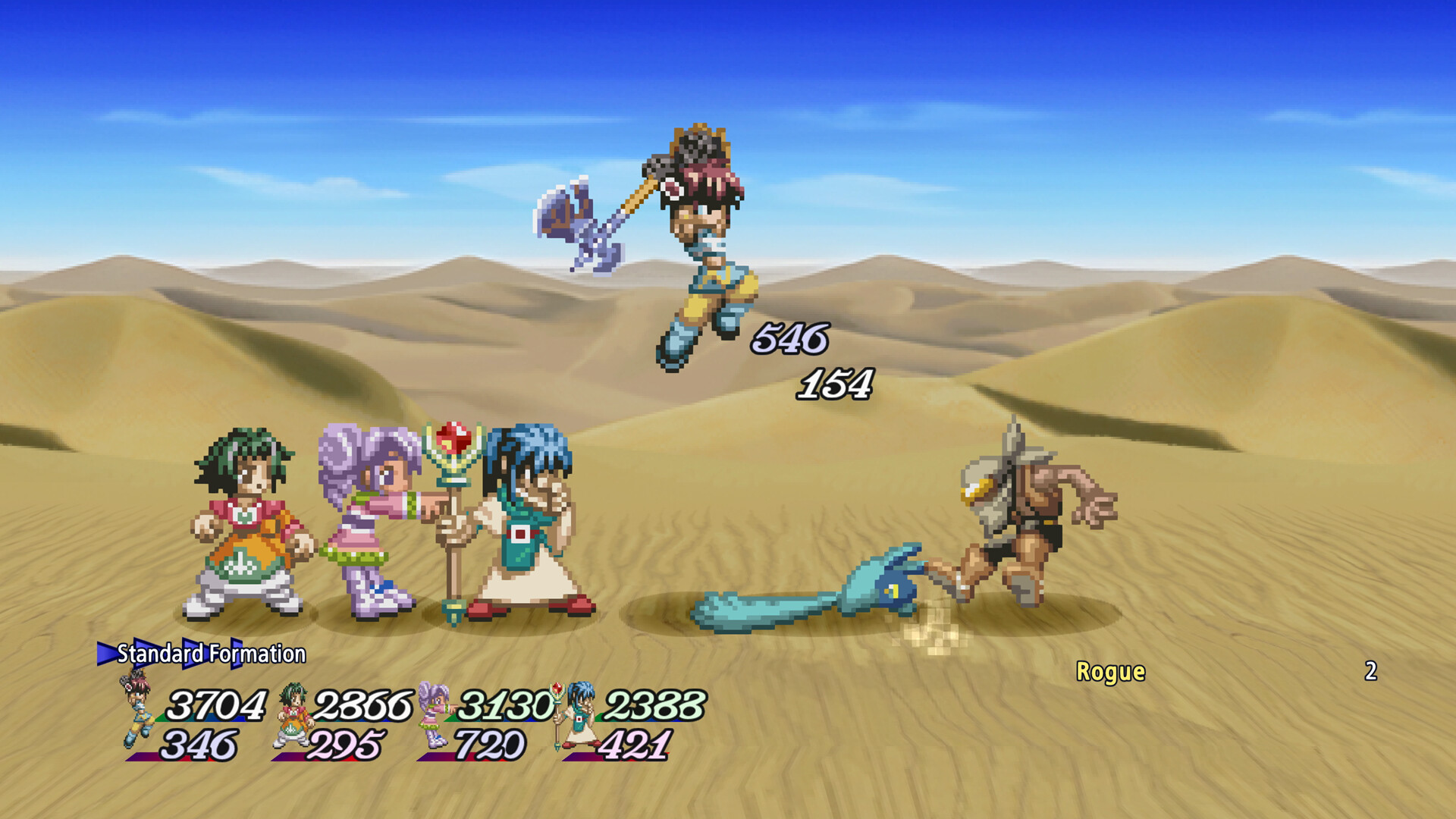
Official Steam promotional battle screenshot, checked 16 October 2026. © Bandai Namco Entertainment Inc. and © MUTSUMI INOMATA. The displayed values describe this promotional scene, not a recommended level or guaranteed damage result.
Start with what the current evidence confirms
The Steam description names the Aggressive Linear Motion Battle System, diverse Arte use, continued combinations, and coordination with unique party members. Bandai Namco’s current game page also identifies dynamic 2D battles. These statements establish the kind of system you are learning; they do not supply exact damage formulas, recovery frames, or an early-game build order.
The official screenshot makes another practical point: battle information and several characters can share a busy scene. Before trying to optimize it, identify which character you currently control and where the game presents the information you need. Read the current menu descriptions for any command or strategy option you intend to change.
Do not read the screenshot’s party arrangement as a requirement for your first hours. Promotional footage can show a later point in the adventure. The correct starting practice uses your available characters and commands, with the current story stage and equipment you actually possess.
Practice spacing with one repeatable question
Enter a manageable battle and focus on one question: where does a chosen action leave your character? Try a basic action when the enemy is near, then watch the resulting position. On another opportunity, approach from a different distance before using the same action. Keep the rest of your plan as simple as possible.
This is an observation routine, not a claim about a particular invulnerability window or movement technique. You are learning the visual relationship between your action and the opponent’s response. If the result is confusing, repeat at normal speed and use fewer inputs. Increasing speed before you understand the sequence makes the feedback harder to interpret.
When you take damage, describe the moment rather than labeling the whole build weak. Were you already committed to an animation? Did you move into a group? Did your attention shift to another party member? A clear description suggests what to test next. A vague diagnosis encourages random changes to several systems at once.
Add one available Arte at a time
Read the description and current command for one Arte that your game has made available. Use it in a simple situation and compare its movement, range, and visible effect with the basic action you already understand. Avoid assuming that a similarly named action in an older guide has identical requirements or behavior here.
Your first comparison does not need a perfect damage calculation. Ask whether you can deliberately choose the action and recognize its outcome. If a resource display changes, check its name and explanation in the current menus before assigning a rule to it. A single screenshot cannot establish every cost, regeneration condition, or exception.
After that comparison, build a short sequence using only actions you can already explain. If it fails, remove the final action and check where the sequence stopped making sense. That is a more useful recovery method than adding more inputs to an uncertain foundation. Save a complicated showcase combo for the point when its individual parts are familiar.
Coordinate with the party instead of ignoring it
The official description explicitly includes party coordination. Start by noticing what the other available characters are doing during a simple encounter. Look for moments when their actions change the situation you are responding to. This gives you context before adjusting any strategy or command settings that your current menus expose.
Change one available party setting or instruction at a time, then compare a similar situation. Write the actual name you changed and what you observed. We are not providing a universal AI configuration because the reviewed sources do not document the complete current menu or guarantee one ideal setting for every encounter.
If several characters appear to be struggling, first check basic readiness in the current equipment and status menus. An unopened menu option, an unfamiliar available command, and a genuine progression barrier require different responses. Do not prescribe a fixed amount of grinding until you know which problem you are trying to solve.
Keep learning battles separate from fast auto-battle
High-speed mode during auto-battle is a documented convenience of the remaster. Its useful role is different from a deliberate practice encounter. If you want to understand why an action leaves you vulnerable or how a party response changes a battle, ordinary-speed observation is easier to interpret.
Before using faster auto-battle for convenience, read the current game’s description and check the situation your party is in. We have not verified a safe universal farming route, an automatic victory guarantee, or how every special encounter interacts with this feature. Do not turn a speed option into an assumption that every fight can run unattended.
Similarly, disabling enemy encounters helps with the pace of travel but is not a combat lesson. If you have spent a session moving through the story with encounters reduced or disabled, assess your current readiness before blaming the next difficult battle on a broken mechanic. The settings guide offers a way to keep those preferences distinct.
Diagnose a difficult encounter in a fixed order
Use the following order when a battle repeatedly goes poorly. It is a planning checklist, not a verified solution to a named boss. Stop when you find a specific issue, test a correction, and compare the result before making the next change.
| Question | A useful observation | A controlled next test |
|---|---|---|
| Can I read the action? | Losing track after several simultaneous effects | Use a simpler sequence at normal speed |
| Do I understand position? | Repeated trouble after one approach | Compare that action from another distance |
| Is the chosen Arte deliberate? | Pressing it without recognizing the result | Test it alone before adding a follow-up |
| Is the party ready? | An available menu or command remains unexplored | Review current equipment and descriptions |
| Am I using the right evidence? | Advice assumes an unavailable command | Find a source for the remaster and story stage |
If the first four checks do not resolve the problem, collect better evidence: the encounter name, your available party, the command you tried, and the moment the plan fails. Those details support a meaningful comparison with current footage. A damage number without context usually does not.
Build your own small battle reference
Keep three notes after a useful session: one action you can execute deliberately, one situation where it helped, and one situation where it did not. Add a party observation only when you can describe what changed. A small reference grounded in your current game is more useful than a copied tier list without version details.
Do not treat this as a requirement to document every encounter. The purpose is to remove uncertainty at the point where it affects your next decision. Once a sequence is comfortable, continue the adventure and revisit it when a new command or opponent asks a different question.
For the initial story and controls baseline, return to the beginner guide. Exact character rankings, frame data, unlock counts, equipment routes, and boss-specific solutions remain outside the verified scope of this page. We will add those only when current evidence supports them.
Step-by-step guide
- Observe position and timing
Use a manageable encounter to see where a deliberate action leaves the controlled character.
- Add one available Arte
Read its current description and compare it alone before building a longer sequence.
- Review party readiness
Check current commands, equipment, and available party settings before blaming the entire build.
Video evidence
Watch creator walkthroughs alongside this guide. Check the recording date before following requirements that may have changed.
Tales of Eternia Remastered - Official Trailer
Launch-period story and battle footage distributed by GameTrailers. Useful visual context; montage footage does not establish exact inputs or prerequisites.
Sources
Recheck these links whenever the game version, release status, or strategy changes.
- Steam: exact game listing Current identity, release listing, A-LMBS, named remaster conveniences, and official screenshots.
- Bandai Namco: official game page Publisher confirmation of the adventure, combat presentation, and current edition.
- Tales of Eternia Remastered – Announcement Trailer Official publisher announcement: the two-world premise, party, and remastered battle presentation. A trailer is not a complete route or unlock guide.
- Tales of Eternia Remastered - Official Trailer Launch-period story and battle footage distributed by GameTrailers. Useful visual context; montage footage does not establish exact inputs or prerequisites.